
Part II: 2019 - 2024
We're off to see the wizard of accredited only investments. What could go wrong?

Don’t miss Part I of this series.
2019-2020
The syndication journey begins
For many years I suspended my real estate investing since purchasing and renovating properties remotely was not complementary to raising our young daughter. However, syndicated real estate investments offered an alternative. I immersed myself in the topic.
I did the work - I read the books, consulted my CPA, had extensive discussions with GPs. I made spreadsheets that projected returns and failure rates based on available data. I made a truly concerted effort to underwrite what I was getting into with the same level of scrutiny and skepticism that I applied to purchasing my own rental properties. But it wasn’t enough.
⛔ False Assumption: Reading everything available is sufficient.
Investor education resources were relatively limited at the time. I spent months intensively educating myself and felt that I was making well-informed decisions. But despite my best efforts my knowledge was severely lacking.
✅ Reality: You will never know everything.
Today, far more and higher quality information is available. But most is created by those selling the product, so it is rare to find the depth of analysis that is required to truly understand what you are investing in. Listen to any expert GP recount the myriad of information they review - and the infinite number of ways things can go wrong - and it should quickly become apparent that an LP is no expert.
2021
We start investing funds
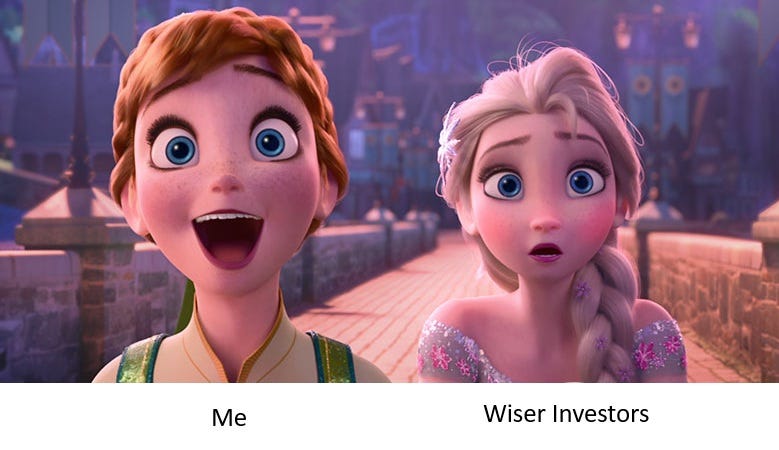
Our life was in a period of intense transition, which demanded my full attention. I knew that the level of due diligence required to assess the quality of a deal required far more time than I had available. So, I outsourced the decision-making. At the time, CrowdStreet offered PMA (Privately Managed Account) services. I spent months getting to know our account manager - understanding his philosophy and creating a strategic portfolio investment plan. I fully understood the fees and was comfortable with handing the reins to a team of experts I perceived as having far more experience and knowledge than I ever could. The plan was made, and funds were transferred for investment.
⛔ False Assumption: Advisors and GPs’ interests are aligned with your interests.
I vetted and trusted my advisor and the GPs. I assumed others’ definition of risk was the same as mine. I assumed that the glossy real estate teams handling multi-million dollar deals were rigorously analyzing the data.
✅ Reality: No one knows and cares about you like you do.
No one lied or deceived me (actually there are one or two but that’s another story). I gave GPs’ and advisors’ opinions and information far too much weight. I assumed they were operating from a place of objectivity. I failed to consistently and continuously look after my best interests.
2022
We do a cash-out re-fi on the rentals and invest more funds
After deploying SDIRA funds, we doubled down and completed a cash-out re-fi on our rental portfolio to access the equity that was lazing around. Which went to CrowdStreet’s PMA for investment.
The strategy was sound: monetize equity and put it to work. Due to favorable lending terms, the cash flow after the re-fi was marginally less than before the re-fi.
⛔ False Assumption: Diversification is always beneficial.
Monetizing equity wasn’t just about maximizing total returns, but diversifying our portfolio. Having a large amount of our net worth tied up in a few properties in one city seemed foolish compared to diversifying across numerous assets and geographies. I assumed diversifying was a superior strategy.
✅ Reality: Not all investments are created equal.
My perceived risk of syndicated real estate was identical to that of equities or our own investment real estate. This is most definitely NOT the reality. Besides asset risk, I also overlooked vintage risk.
2022 - 2024
Asleep at the wheel
As life sped up and funds were invested, the quarterly reports came and went unread and we remained blissfully ignorant to what we owned and what was happening. A few deals exited and provided generous returns. All was going so well.
Then the distributions stopped, the capital calls came, and the performance reports went from “on-track” to the alarmingly frequent use of “distressed”.
⛔ False Assumption: Change of key management is not a concern.
When our account manager at CrowdStreet disappeared, a new team and structure was implemented. I didn’t think twice about it. I assumed it was for the best and that the new team was on board with our plan.
✅ Reality: Change in key staff is a big, giant, enormous warning sign that must be heeded.
All those months vetting and discussing were lost with the account manager. In reality, I had no idea who was now selecting deals for us and what their decision-making was based on.
When I finally took the time in 2025 to review the initial offerings, a large majority of deals had red flags all over them. I had the skills but not the time to choose wisely. Making a good investment requires both, not one.
⛔ False Assumption: There is no need to monitor passive investments.
I thought “The money is invested. What’s the point of reading all these quarterly reports?”
✅ Reality: Warning signs are apparent to those who care to see them.
If I had been reading the reports, I would have started to see all the ways deals can go wrong and the market distress signs sooner. Perhaps that coupled with the loss of our account manager would have caused me to question the wisdom of continuing. But no, I was driving blind and headed for the cliff.
⛔ False Assumption: The case for a capital call is financially sound.
I assumed the GP wanted what we wanted - to make money. That is, of course, true but the means to the end are different for GPs and LPs. I assumed the picture painted by a GP in a capital call was a comprehensive and fiscally-sound plan.
✅ Reality: A capital call requires due diligence like any investment.
Most of the capital calls we made were based on very little understanding of the underlying issues and how realistic the revised business plan was of succeeding. By the time I started doing meaningful analysis in 2025, the pure lunacy of most of these plans was blatantly apparent to me.
Coming next…
We’ve driven off a cliff and the ground is coming up fast.
Next time I’ll discuss how I dug through the car wreck of our portfolio, and lived to tell about it.
Thank you for sharing your experiences and lessons learned. You are not alone!