
Part I: the 2010s
It's not interest rates, but assumptions that brought us to Net Zero

This story starts back in 2010 long before syndications were hot and interest rates at zero were accepted as a market norm. This three-part series will outline my journey and highlight the many assumptions that led to today’s net zero “win”.
2010s
Ghosts of GFC Past
The Great Financial Crisis (GFC) taught me a lot and allowed us to build foundational wealth as the economy began to recover. However, it also left me with several false beliefs that led to bad decision-making many years later. The false conclusions are understandable, but what is most surprising (and scary) to me in hindsight is that these were mistakes made by two MBAs who regularly read investment circulars. We are not CFPs (and have perhaps foolishly never consulted one), but it seems we knew just enough to be dangerous. Know thyself.
False Belief #1:
It is not possible to fund a comfortable retirement by utilizing retirement plans. Investors must utilize alternative wealth-building vehicles.
After my daughter was born in 2010 and I was not working, I spent a lot of time observing how other people had gained wealth and attained a comfortable retirement - especially immediately after a recession. I saw two options: 1) a pension (which no longer exists), or 2) own a successful business or real estate. I did not observe any retirees living off of their retirement accounts. So, I made the logical, but flawed, conclusion that retirement accounts alone are not a realistic path to retirement.
⛔ False Assumption: Retirement accounts have been widely available since like forever.
✅ Reality: 401(k) and IRA programs were not widely used until the early 1980s.
The reason I did not see any retirements funded by retirement plans in 2010, was because it would have been mathematically impossible; the availability, limited contribution amounts, and short timeline would not have made this possible by 2010.
👉🏽 The Truth: Retirement accounts can work.
A person with a good income and strong saving and investing habits can absolutely fund retirement using main-stream retirement accounts. Can you retire early? Probably not. Will you be “wealthy”? Also, probably no. Financially secure? Probably yes.
False Belief #2:
Investing in stocks does not build wealth.
After experiencing the “Lost Decade” of net zero returns for US stocks from 2000-2009, it was logical, and - again - incorrect, to make the conclusion that the seemingly linear return assumption of a compounding 8% used by brokerages was fundamentally broken.
⛔ False Assumption: A well-crafted retirement account is composed strictly of US stocks.
✅ Reality: Modern Portfolio Theory is based on diversification well beyond US stocks.
While Modern Portfolio Theory (MPT) has existed in academics since the 1950s, it was not broadly accepted and applied to personal investing until the 1990s. Before that time, the approach was similar to my false belief that prevailing retirement strategy is limited to investing in US stocks and is thus subject to wild fluctuations in returns.
👉🏽 The Truth: MPT works.
Even during the Lost Decade an investment using MPT would have provided a net positive return. The data strongly supports the validity of MPT.
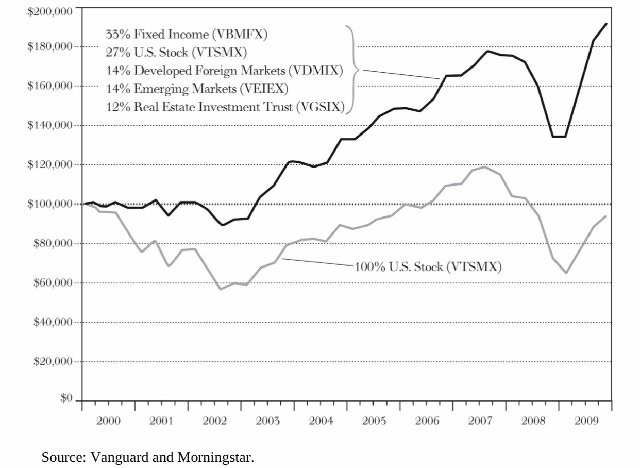
The fall-out: Heavy allocations outside of the traditional index funds.
On the plus side, we purchased our own rentals, and employed robo-advisors like Schwab’s Intelligent Portfolio - both of which have served us very well in building wealth.
On the con side, we purchased a lot of syndicated investments, most of which have not provided the anticipated financial benefits, but have provided a rich environment for life lessons.
The next part of the story will cover the missteps of 2019 - 2024: the critical period of deploying capital and how you can avoid taking your own path to Net Zero.