
THE DEBRIEF: Bond. James Bond-like Returns.
Armed with a 30% capital call infusion and good luck, a nimble GP took investors on a wild ride of high hope, near doom, and a lucrative exit.

This is The Debrief - a post-game analysis for LPs. Breaking down the plan, the reality, the result, and key takeaways of actual real estate syndication investments to better understand risk and invest accordingly.
To respect the confidentiality of private investment vehicles, all names, locations, and proprietary figures have been anonymized or rounded. Alignment with actual investment metrics is purely coincidental.
The analysis provided is for educational purposes to illustrate market mechanics and risk management.
The Plan
Value-add and expansion of a light industrial property using a well-known and routine business plan. It should have been boring. It wasn’t.
The plan was to:
Purchase industrial warehouse space and land from the existing tenant under a short-term lease-back agreement, at a rate approximately 20% below prevailing rental rates.
Add substantial value by:
Bringing rents to market rate, and
Constructing new industrial space on underutilized land. The new building would expand the square footage by 50% and more than double the number of valuable high-dock door counts.
Stabilize and sell.
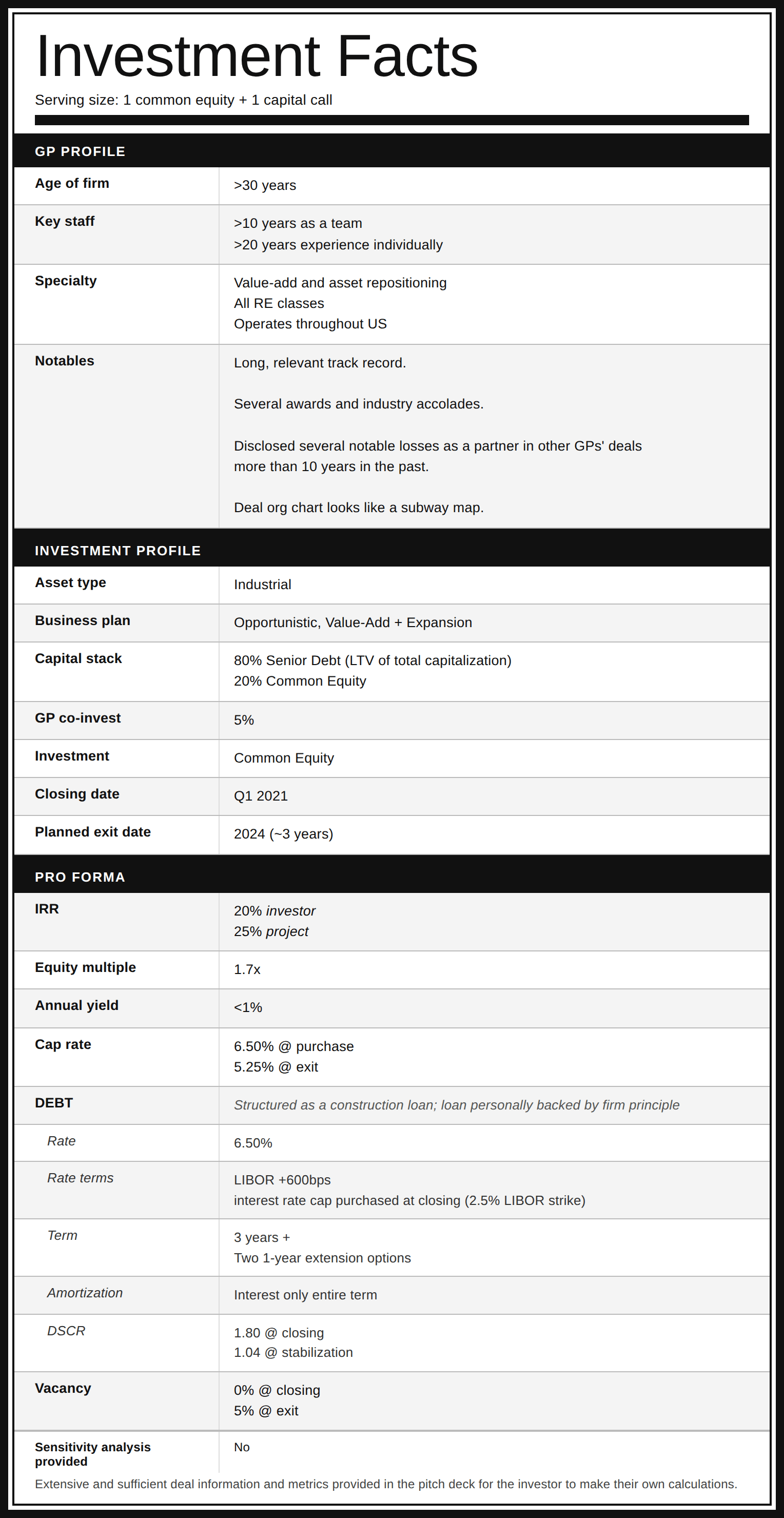
Below is what you need to know from the offering materials.
The Reality
Where things deviated from the plan:
The Original Plan was a Market Failure
Between the time of the investment offering in Q1 2021 and Q2 2022, the viability of the business plan was clearly in jeopardy:
Although protected by a rate cap purchased by the GP at closing, the effective interest rate was 2pts and 30% higher than the original underwriting.
Construction costs were rapidly increasing due to inflation.
Replacement tenant cancelled their occupancy plans due to market uncertainty. Overall tenant demand softened and leasing interest cooled.
By the end of 2022, it was clear that investor capital was at extreme risk and that a major change was needed to avoid losses.
A Completely New and Different Plan is Made
At the beginning of 2023, the GP identified a far simpler and more favorable business plan: sale of the site as “powered land”. This required securing the proper zoning and entitlements, but no capital improvements were required - the site is sold “as-is”.
Demand from data center providers was known and buyer interest was already secured.
Substantial Capital Infusion Required
Despite having a “bird in hand” business plan, the GP still made a 30% capital call in late 2023 to get it done. Why?
Despite the rate cap, interest reserves on the construction loan were quickly exhausted due to the site being completely vacant since early 2023. The shift to a data center precluded placement of a full or partial tenant, which resulted in zero income. During this time, the GP covered the operational cash flow gap at a value of more than $2M.
The loan was for construction, not entitlements, which left the original credit unavailable for use under the new plan.
In order to execute the new plan, the GP issued a capital call amounting to 30% of the original investment. It offered investors:
Preferred class shares (senior to the original common equity shares).
Boosted preferred return (40% higher than the original common equity shares).
Non-dilution. LPs that did not participate were penalized with simple dilution from the issuance of the new senior shares.
Fairness. The GP stated it would fill the capital call not provided by LPs. By providing LPs the opportunity to participate, the GP allowed LPs to maintain their interests alongside the GP.
If my work has been worth your time, please subscribe.
The Result
Despite a death-defying ride en route, the deal still landed at the edge of the bullseye.
How it happened:
Seeing market conditions worsening, the GP was quick to respond by:
securing a rate cap at closing;
exploring alternative uses as soon as the fundamentals of the original plan showed signs of failure;
funding cash flow gaps and personally guaranteeing the necessary capital to shift to the new plan;
swiftly executing the new plan and closing under highly favorable market conditions.
While the quarterly reports read like an adventure novel where the deal seems on the verge of doom at every turn, the expertise of the GP resulted in a heroic pivot and not only saved - but rewarded - investors with a 2pt IRR premium and only a 2-month exit delay.
Flaws apparent in the pitch deck
Could this wild ride been anticipated and avoided altogether? Perhaps…
Historic Delivery Highs Outpacing Absorption
At the time of the offering, industry data clearly showed peak delivery of industrial square footage in the area with industry analysts warning that deliveries were already outpacing demand. The GP noted these same record deliveries as evidence of strong demand while failing to note the more relevant looming market imbalance, and possible softness as inventory was delivered. The business plan assumed that demand would continue to at least match or outpace deliveries; any notable deviation would materially jeopardize the viability of the project. Which is exactly what happened.
Construction Costs
Like interest rates, signs of significant construction cost increases were already well-documented by late 2020. While the GP addressed the potential for interest rate increases by purchasing a cap, an increase in construction costs was not considered in the underwriting.
Data Center Oversight
The proximity of the site to a power center coupled with strong and growing demand for data centers was known at the time of the offering, however this option was not considered until the value-add plan was clearly untenable.
Key Take-Aways
All’s well that ends well, BUT this very well could NOT have ended well….
What if the data center were not an option?
There is a very high likelihood that the deal would have been a complete loss due to the impossible market conditions that were to come:
Market demand collapse
substantially reduced income due to increased vacancy and decreased rental rates. Although the project underwrote a conservative break-even point of a 20% vacancy rate (nearly double the historic average), this did not account for additional layers of stress, such as:
Increased debt burden
although less than the prevailing rate, the actual debt burden was 30% higher than the underwriting.
Construction cost increases
in material and labor doubled over normal rates during this period. This presented a serious challenge to the viability of the project.
Be Aware of the Market Cycle
It is incumbent on the investor to recognize where the pro forma data falls within the market norms. The story in the offering materials may not align with reality. By recognizing how aggressive or conservative the pro forma metrics are in comparison with current and historic market metrics, the investor can easily and quickly assess the risk profile.
Bottom Line
This was an aspirational plan from the beginning; market warning signs were already present at the time of the offering. Although the GP was able to think fast and direct the deal away from imminent doom, it was a combination of good luck and skill that provided a positive result. For the investor, although the original business plan was mundane, available data made it clear that this deal was pushing its luck. It’s the investor’s responsibility to recognize those risks and invest accordingly.
Always great to see creative sponsors who can adapt to changing market conditions. I also appreciate you sharing a capital call example that clearly makes sense to participate in—many LPs tend to avoid them entirely, even when they can be a smart decision.