
THE DEBRIEF: The Sirens' Song
Billions were poured into crowdfunding; millions were lost. It went surprisingly well.

This is The Debrief - a post-game analysis for LPs. Breaking down the plan, the reality, the result, and key takeaways of real deals to better understand risk and invest accordingly.
The analysis provided is for educational purposes to illustrate market mechanics and risk management.
This week I’m breaking down the spectacular rise and fall of crowdfunding. The history, how it happened, and the perfect storm of conditions that left little chance of survival for anyone involved.
I’m combing through the wreckage of defunct platforms, dead deals, and disillusioned investors that was the culmination of nearly 100 years of previous catastrophes. To see how that happened, we need to go back to 1929.
But first, let’s play a game. Match the following events to the condition(s) that created it.
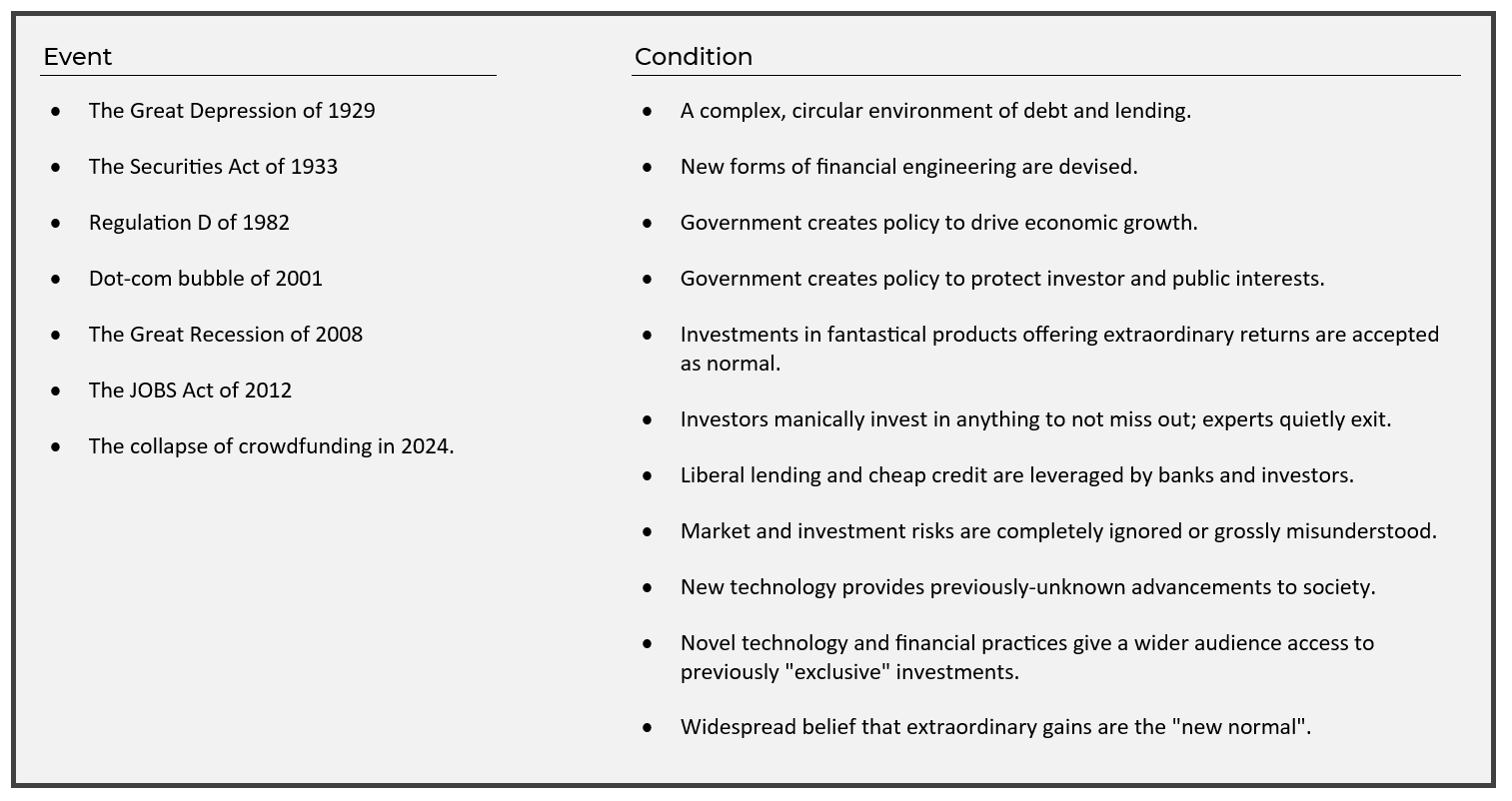
This is actually a trick question since each of these events was driven by the same bubble-forming conditions.
The Economy in 1929
After World War I, the US became an economic and political superpower. America’s economy was booming due to:
Seemingly infinite domestic production capacity and sales to Europe.
New investment products that allowed investors easy access to equities.
Low interest rates, liberal lending, and highly-leveraged investing practices.
The party came to an end in 1929 when the stock market collapsed and set off a chain of events that created the Great Depression.
Legislative Reform of 1933-1934
In an effort to avoid another Great Depression, the federal government passed sweeping legislation1 that required any company selling securities to the public to:
Register with the Federal Trade Commission (and later the SEC).
Disclose the company’s business, its financial health, and the specific risks involved in the Prospectus provided to each investor.
Be Liable for any material misstatements or omissions made.
Comply with anti-fraud provisions prohibiting insider trading and market manipulation.
This also created the exemption system, which permitted the sale of private equities, but prohibited advertising.
The Economy in 1980
The reforms of 1933 and 1934 effectively protected the US economy from volatility, but by the late 1970s it was clear that these same regulations were causing a new set of economic problems: flat markets, limited availability of lending for small businesses, banking woes, and high inflation.
Legislative Reform of 1980-1982
In response to poor economic growth, the emergence of the tech sector, and a concern that the US was falling behind its global competitors, the federal government loosened some of the 1933/34 restrictions. This included an order that the SEC create a simplified system for private offerings.
In response, Regulation D was created in 1982, which defined:
Fundraising rules, including Rule 506, which allows unlimited capital raises but access is limited to Accredited Investors only.
Accredited Investor qualifications.
Note that the static “Accredited Investor” definition of 1982 has completely lost its intent of limiting access to the top 2% of households; nearly 20% of US households now qualify as accredited. This has effectively expanded access to private offerings from the ultra-wealthy to the working rich.
Click here to read more about the history and implications of the Accredited Investor designation.
The Economy in 2010
Following the regulatory easing of 1980 and the explosion of new tech companies, the US economy faced a new set of challenges:
Unemployment persisted after the dot-com crash and Great Recession.
Access to capital for small businesses was still inaccessible.
Crowdfunding platforms demonstrated a strong public desire to invest in small, emerging companies.
The internet and social media made the non-solicitation restrictions appear archaic and unenforceable.
Stockholder limitations were strangling fast-growing tech companies that wanted to stay private while providing employees with stock options.
Legislative Reform of 2012
To correct these issues, the JOBS Act of 2012 made the following changes to Reg D:
Lifted the ban on General Solicitation. For the first time since 1933, a private investment offering could advertise publicly.
Access to the masses. Private offerings could be sold to non-accredited investors, but required use of a FINRA-registered intermediary, provision of standardized disclosures, and per-investor limits2.
Ability to remain private. Companies could remain private with up to 2,000 shareholders (or 500 non-accredited shareholders). This allowed private deals to scale to the size of public companies while avoiding the administrative costs and disclosures required of public companies.
If my work has been worth your time, please subscribe.
The Frenzy of the 2020s
By 2022 - ten years after the JOBS Act - the US real estate crowdfunding market had grown from zero to over $15B. The industry's trajectory was steep: from just over $1B globally in 2014 to cumulative raises exceeding $50B3 from approximately 1 million investors by the end of 2020. The JOBS Act made it all possible, but the rapid growth was driven by:
Persistently low interest rates. A decade of historically low interest rates coupled with a belief that interest rates would stay low forever drove economic growth in all sectors.
Availability of cash and time. Low unemployment and an inability to spend money during the pandemic provided investors a sense of having wealth and a lack of ways to spend it. Crowdfunding benefitted from the widespread availability of time and money, which may have otherwise been spent elsewhere.
Search for yield. A combination of factors made syndications particularly appealing in comparison to public equities:
Stock market returns were strong and averaging 12%. In order to attract investors, syndications projected returns in the high teens that were based on a combination of strong market conditions, cheap debt, and financial engineering.
Favorable tax code changes made real estate highly tax efficient. Investing in syndications permitted LPs to enjoy the same tax advantages of owning real estate directly.
Real estate was promoted as a stabilizing alternative that was resistant to inflation, volatility, and loss of value.
Self-directed retirement accounts. Between 1995 and 2000 a series of legislative changes and IRS directives made self-directed retirement accounts viable. The emergence of online custodians (such as Equity Trust), made the use of self-directed accounts easy. This permitted investors to direct their retirement accounts to assets outside of traditional brokerages, which accounts for about 20% of all crowdfunded investments.
Rising tide of appreciation. After the Great Recession, real estate enjoyed ten years of reliable appreciation. As investors saw the seemingly guaranteed returns resulting from rising market valuations, more money flooded in (thus raising demand and prices). Under such conditions, it was easy for a GP (no matter how inexperienced) to show a track record of remarkable returns.
Novelty. Investors were suddenly offered an array of exciting new investment vehicles that permitted ownership of assets that were previously only accessible to family offices and institutions: self-directed accounts, crowdfunding platforms, a plethora of opportunities spanning all types of real estate, and low investment minimums. Investor demand was insatiable. Everyone wanted to “invest like the 1%”. Dozens of crowdfunding platforms and thousands of GPs sprung up like mushrooms to capture a piece of investors’ enthusiasm.
After reading this list, are you sensing an eerie similarity to the table of conditions and resulting market collapses presented at the introduction?
The Collapse
Even if you didn’t directly experience the abrupt ending in 2023 of the syndication orgy, I hope you can see the pattern now that we’re at round three of a burst bubble.
What caused the crowdfunding party to go bust?
INTEREST RATES
The Fed abruptly raised rates in Q1 2022. By mid-2023, deals were drowning in the cost of their debt and asking for more capital just to service their loans. In 2024 and 2025, the debt burden and investor unwillingness to provide additional funds manifested into defaults and lost investor capital. At the same time, the combination of bad press, investor caution, and capital locked in stalled-out deals cut investment capital flow in half.
For an explanation of how debt led to default, see The Debrief that covered how a strongly-executed value-add deal still went broke.
By 2025 the market had bottomed out and the number of crowdfunding platforms had shrunk. Today a majority of transaction volume has consolidated to the top five platforms4, and the amount of retail investment capital flowing into real estate syndications is only about 20% of what it was in 20215.
The Response
While the losses are real, the distress experienced by GPs and LPs in syndicated real estate did not create a larger economic death spiral nor destroy the life savings of investors and non-investors alike. The restrictions put in place by the 1933/34 and 1980/82 legislation prevented the folly of a few from destroying the financial security of everyone.
However, the federal government did respond to the abundance of distressed loans by modifying lending rules to essentially permit “extend and pretend”. This allows banks to work with syndicators to extend loan terms rather than forcing a foreclosure - a lesson from the Great Recession. Although this is an option, not a requirement. Not all lenders are willing to repeatedly renegotiate the terms of a loan, if at all.
Key Takeaways
Losing money is always painful - an experience I know all too well. Let’s review some of the most common LP complaints about crowdfunding in light of everything we’ve just covered. For the sake of argument I will use Crowd Street as the sample platform since it is one of the market leaders and one I am familiar with.
Investments were thoroughly vetted, and were implied to be “safe”.
Crowd Street did actively advertise the amount of due diligence performed and the small percentage of reviewed deals that made it to the platform. All of which directly or indirectly implied a level of safety to investors.
However, this did not ensure any guaranteed return. The offering information provided was extensive, well-organized, and explicitly stated the risk of losing one’s entire investment. In accordance with the rules, private offerings are made with the assumption that the investor has the knowledge, skill, and sufficient wealth to make prudent investment decisions and sustain any losses.
Retail investors are only offered the “crumbs”; institutional investors get the best deals.
This is absolutely true, and a reality of life. It is much easier and more efficient for a GP to raise millions from one institution than $50,000 from hundreds or possibly thousands of investors.
However, it does not mean that the “crumbs” are bad deals. But what makes a deal good or bad is for the investor to determine.
Only good news is communicated.
Crowd Street does require GPs to provide quarterly reports, but there are surely GPs that are shirking their duties.
However, this is not a problem bred by crowdfunding; private offerings have few requirements and little oversight. A lack of information is, unfortunately, part of the ecosystem.
Funds are trapped.
Many offerings were advertised as three-year holds, which now - five years later - are not only delayed but have no known exit date. There is no secondary market, so capital is trapped.
However, this was communicated in the offering materials. The management of the asset is the responsibility of the GP - an apparent benefit to LPs that were seeking “passive” income - but a perhaps unforeseen consequence of relinquishing control.
Bottom Line
It is understandable that LPs may feel confused, angry, and/or betrayed. So, let’s offer ourselves some grace:
Avoiding the temptation of the sirens’ song of an extraordinary investment opportunity is extremely difficult.
Crowdfunding and real estate syndications were novel and information was limited in 2020. Even the most informed of investors were woefully ill-equipped to make good decisions.
AI and other helpful resources did not exist. Today, there are far more resources available to assist investors in making better-informed decisions.
But also accept that:
Ignorance is not an excuse.
Wealth does not equal wisdom.
Growth comes from loss if we choose to face our mistakes.
Most importantly, by learning to recognize the signs of a market frenzy, we can steel ourselves against the irresistibly fatal and perennial arrival of the song of the sirens.
Underlying the swing between greed and fear is the swing between euphoria and depression.
-Howard Marks
Your Turn
Comment below to share your experiences, lessons learned, or current approach to crowdfunding.
Sources
The Securities Act of 1933, The Glass-Steagall Act of 1933, and The Securities Exchange Act of 1934.
Sources: SEC, Regulation Crowdfunding effective date, 17 CFR Parts 200, 227, 232, 239, 240, and 249; SEC, Amendments to Regulation Crowdfunding, November 2, 2020.
U.S. annual capital formation figure: NAIOP, Real Estate Crowdfunding: Solid Growth, But Challenges Remain, Spring 2022, citing the author’s analysis of SEC data. https://www.naiop.org/research-and-publications/magazine/2022/spring-2022/finance/real-estate-crowdfunding-solid-growth-but-challenges-remain/
Global $1B milestone in 2014: Massolution, 2015CF-RE Crowdfunding for Real Estate, as cited in GlobeNewswire, March 3, 2015. https://www.globenewswire.com/news-release/2015/03/03/1022886
Cumulative $50B figure through 2020: GowerCrowd, 2021 Real Estate Crowdfunding Statistics and Trends, citing proprietary GowerCrowd analytics. https://gowercrowd.com/real-estate-insights/real-estate-crowdfunding-statistics-trends
SEC DERA May 2025 report (Analysis of Crowdfunding Under Regulation CF, sec.gov/files/dera-reg-cf-2505.pdf)
McKinsey & Company, Global Private Markets Report: Real Estate, March 10, 2026. https://www.mckinsey.com/industries/private-capital/our-insights/global-private-markets-report/real-estate, citing Dale, N., CRE Daily, January 29, 2026.