

This is The Debrief - a post-game analysis for LPs. Breaking down the plan, the reality, the result, and key takeaways of real deals to better understand risk and invest accordingly.
To respect the confidentiality of private investment vehicles, all names, locations, and proprietary figures have been anonymized or rounded. Alignment with actual investment metrics is purely coincidental.
The analysis provided is for educational purposes to illustrate market mechanics and risk management.
Every pitch deck is a story. The honest ones describe what the numbers can plausibly do. The dishonest ones describe what the sponsor wants the numbers to do.
This deal was the second kind.
The Plan
Typical value-add business plan of a 100-unit Class C multi-family apartment complex. NOI and asset value would be increased via a combination of light renovations, mark-to-market rent increases, and operational efficiencies. Upon stabilization, the property would be sold after a planned five-year hold. The GP is a deal-specific, 50/50 JV between “Greystone” and “Alpha Capital”*.
*names are fictional
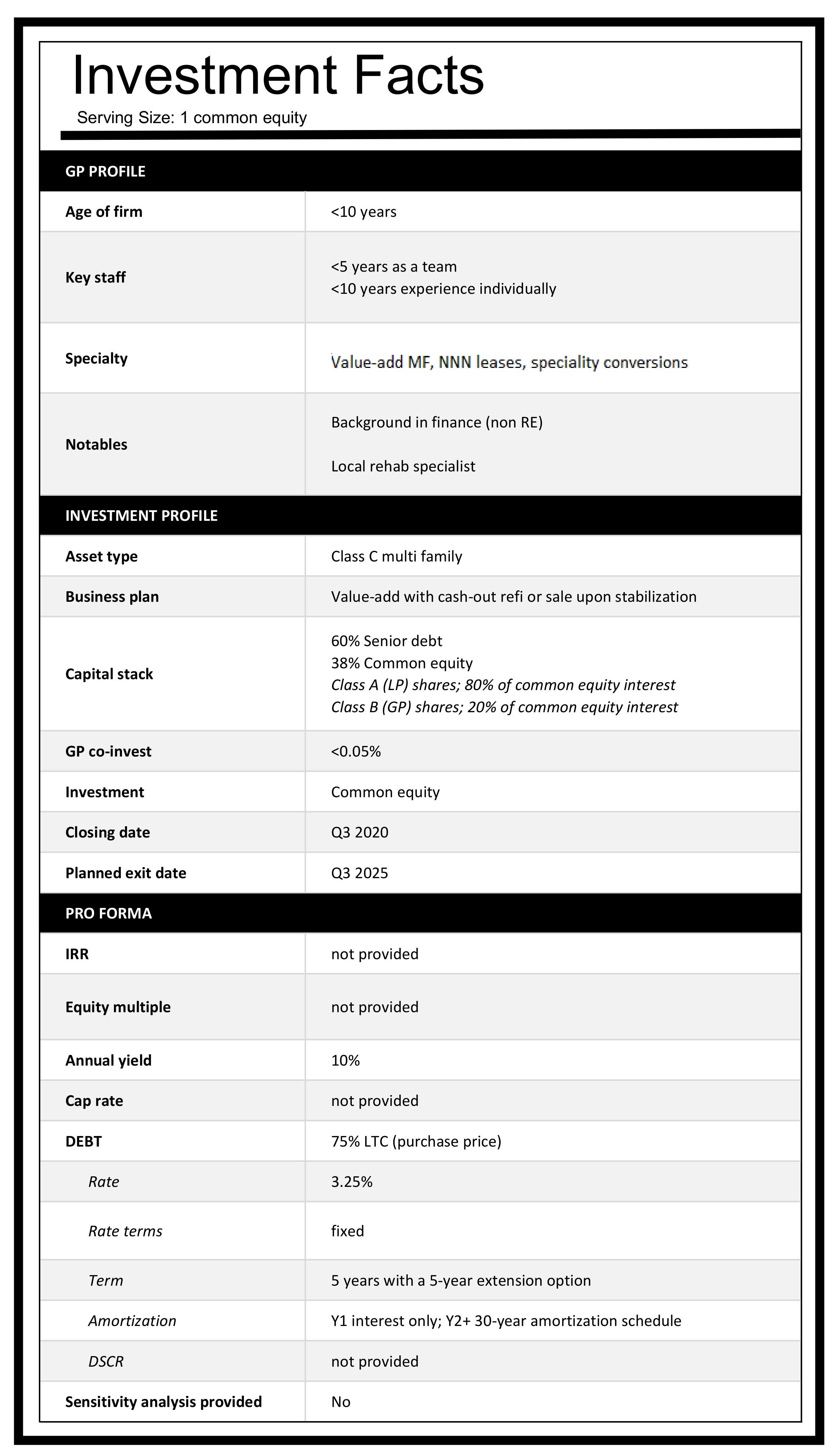
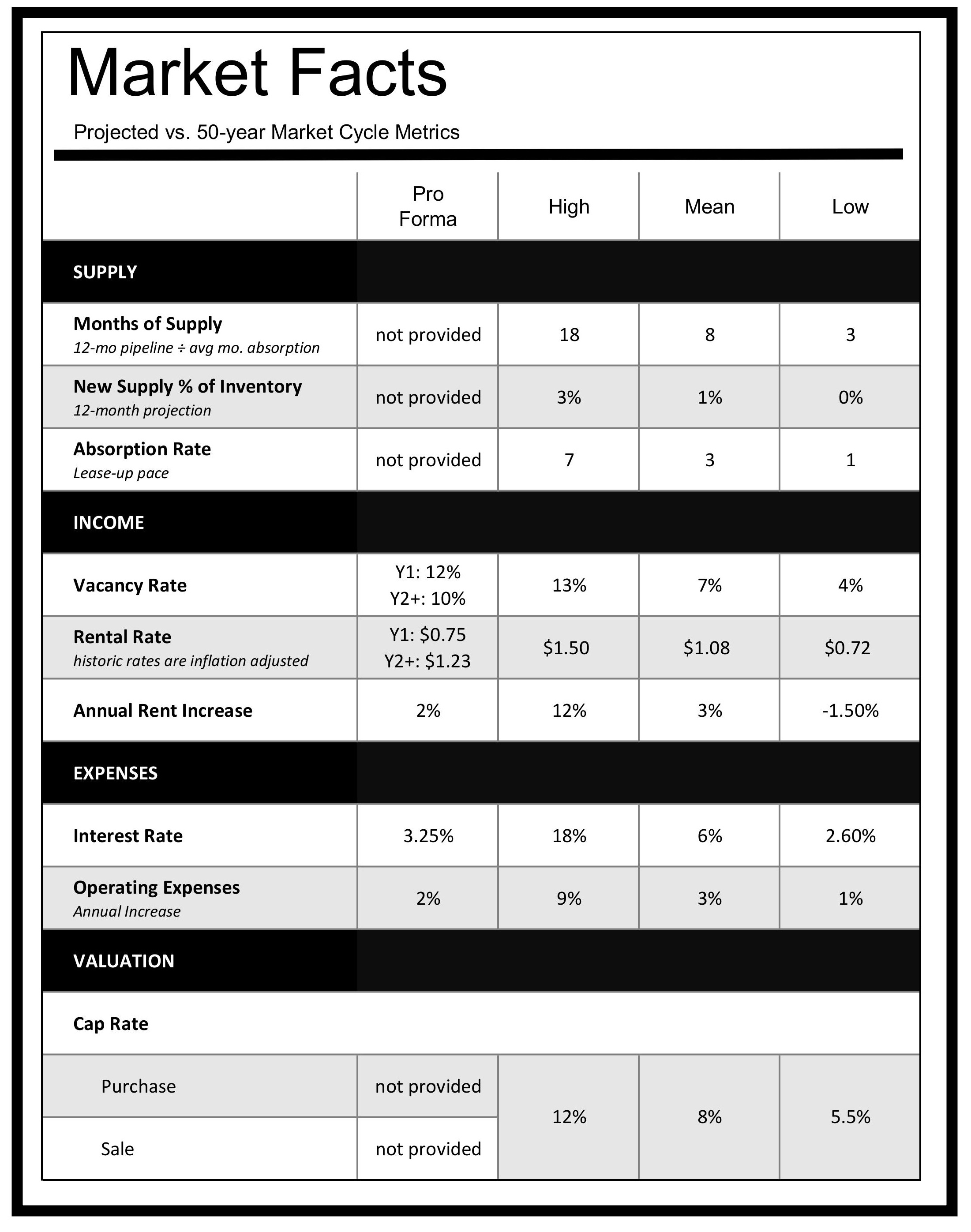
Flaws Apparent in the Offering
If reading the Investment Facts hasn’t filled your mind with expletives, allow me to point out a few red flags:
Green team whose experience is limited to one of the most robust real estate market periods in modern history.
GP co-invest is less than 0.05% of capitalization but common equity interest is 20%. A spread of a few points between GP co-invest and equity interest isn’t unusual, but this spread is astronomically large.
Absence of key, basic metrics. With the limited information provided, the investor has no way of understanding operational cash flow and - more importantly - how the asset will turn a profit.
The pitch deck is indicative of a GP who either doesn’t know better or assumes investors don’t know better. Any one of the following is reason enough for a hard stop.
Irregular, incomplete, and flawed accounting in the pro forma and investment returns calculations. For example, vacancy is listed as a positive (not negative) number. Line items are gross figures and standard accounting methods are not used.
Rent lift was largely based on renewals to market rate, but additional lift was planned via renovations, with a budget of approximately $2,000 per unit. Even in 2020, $2,000 didn’t buy much.
Operating expenses budget was at least 30% below industry norms with no justification.
Comps are stated as a market average number with no supporting evidence. Market fundamentals are overly optimistic against industry reports.
Vacancy is not reflective of the business plan; renovations and rental increases are spread over Y1-Y3, but increased vacancy is only accounted for in Y1 and remains unchanged Y2-Y5.
Investor returns are confusing: the only metrics provided are CoC and ROI.
There is no defined investor exit counter to the stated hold time of 5-7 years; the pro forms shows annual distributions of about 10% and 60% return of capital via a cash-out refi mid-hold with distributions continuing thereafter.
As presented, the combined returns to investors represents 110% of their investment over five years (not the stated 101% ROI), which calculates to an IRR of 2.5%.
To sum up: we have a standard value-add multi-family deal that uses some reasonable assumptions. However, many key numbers are not provided, the GP gets a 20% stake for a 0.05% investment, the math is flawed, and there is no demonstrated path to how this deal will provide a return. What could go wrong?
For an explanation of the importance of cash flow and investor calculations, check out the pro forma tutorials covered by the Heuristics series.
The Reality
At the end of 2020 the capital raise ended. Over the next two to three years, investors were expecting to receive 10% cash-on-cash returns paid on a quarterly basis as NOI was improved and the operations stabilized. By early 2025, investors were anticipating either a cash-out refi or sale to return all initial capital invested and ultimately wrap up the deal.
That’s not even close to what happened.
Year one reports for 2021 were glowing and distributions were double the projections.
In the first part of 2022 the GP was simultaneously issuing distributions and claiming positive results, but financial reports showed substantial negative cashflow. By the end of the year, distributions had stopped and the ballooning negative cash flow was blamed on poor rent collections. In the course of less than 18 months the property had gone from overperforming to grossly underperforming.
We’re going to pause right here to do some math:
In the first 18 months of operations, the project distributed approximately $250,000 back to investors. According to the 80/20 waterfall agreement:
80% went to LPs: a 20% return on investment and double the projected CoC returns, and
20% went to the GP: a 5000% return on the GP’s investment.
By month 19 NOI was reported as -$100,000. It was not mathematically possible for distributions to be provided by free cash flow. It appears distributions were coming from cash reserves (i.e. investor funds).
The waterfall agreement stipulated distributions be made after the settlement of all liabilities. It appears that if the GP was distributing investor capital before settling liabilities, the GP was not only violating the terms of the waterfall agreement, but was also disguising return of investor capital as a return on investor capital. If true, this is unethical, a violation of the operating agreement, and potentially fraudulent.
By 2023, the deception had grown:
Greystone brought in $500,000 in junior debt via a separate entity. The addition of the junior debt was done without Alpha Capital or the LPs' knowledge, and in violation of the deal terms.
A sale was canceled when the buyer discovered that property information was misrepresented.
A lack of financial records was blamed on the property managers.
Despite deep losses shown on financial statements, the report verbiage stated that the project was outperforming.
By 2024 the junior debt was in default, and investors stopped getting financial reports.
By 2025 the deal had completely spiraled out of control:
The junior debt was in default.
The senior debt was in default.
Alpha Capital issued a formal notice of disassociation to Greystone to remove Greystone from the deal.
By the end of 2025, Alpha Capital was working to exit all interests from the deal. LPs voted to replace the JV with Alpha Capital as the sole managing member and utilize the “good cause” clause of the operating agreement.
The asset was sold at the end of 2025. After accounting for the balance of senior and junior debt (including principal, accrued interest, and fees) plus operational liabilities, legal holdbacks, and buyer credits, the remaining sale proceeds returned less than 25% of LPs' original investment.
If my work has been worth your time, please subscribe.
The Result
Nearly six years from the time of the pitch deck, LPs are left with a final K-1, a token return of their invested capital, and few explanations.
We can only guess at the mechanics: It appears that during the first two years, the GP violated contractual agreements and potentially acted fraudulently on at least two terms:
Distributions not in compliance with the waterfall terms; and
Procuring junior debt unilaterally.
No matter what the rationale, actions like this are not only immoral but have serious financial implications for common equity investors. In this case, the addition of the junior debt in a senior position to common equity meant that upon disposition, the total junior debt payoff consumed the equivalent of 60% of the common equity investment - leaving LPs with less than 25% of their investment rather than nearly 75% had the agreed-upon capital stack remained in place.
Where did the money go?
For a deal projecting a 10% CoC return, with fixed-rate debt, more than $200,000 raised for renovations and nearly $150,000 in reserves, how did the project burn so much cash?
The picture is murky at best; financial statements were provided inconsistently and stopped completely after 2023.
What we do know for 2021 through 2023:
Projections were not aligned with reality from the beginning.
Gross rents were approximately 10% less than projected, operating expenses were 30%-60% over budget, and capital expenditures more than doubled. With the addition of excessive distributions in the first 18 months and the amortization of debt beginning in Y2, the project quickly went negative in Y2 and never recovered.
Funds are not accounted for.
The financial statements reported expenditures at a granular level of detail, but the final sale settlement suggests that these liabilities were not accurately reported:
Utilities were reported as paid at double the planned budget, but the final settlement paid out the equivalent of several years’ worth of unpaid bills.
Rent losses suddenly exploded in Y2 with no explanation.
Debt is noted as paid in full. However, the junior debt was collected but not reported. Neither the senior nor junior debt appear to be paid after 2023, but we have no records to determine when payments stopped. This is at the same time all financial statements were no longer provided due to “technical issues.”
Deception is everywhere.
With so many unclear and unexplained data points, little can be certain other than the gross ineptitude of Greystone from the beginning:
Financial projections were incomplete and deeply flawed (intentionally or unintentionally).
Financial statements are inaccurate and incomplete (intentionally or unintentionally).
The actual sources and uses of cash are inaccurate and incomplete (intentionally or unintentionally).
The junior debt party was potentially provided fabricated data sufficient to procure the cash advance. Or investors were. As reported, it is unlikely the GP could have procured additional capital.
Greystone appears to have provided misleading and false information to lenders, Alpha Capital, and investors.
Greystone is keeping its secrets and Alpha Capital hasn’t provided a final accounting. Investors deserve answers. That doesn’t mean they will get them.
Bottom Line
The Debrief has reviewed a range of deal structures and their outcomes. Some good plans faced bad circumstances. Some plans wrongly assumed the good times would never end. This deal didn’t have a good plan; only a good story.
A story so good that the GP collected a 5000% return on their initial investment, and possibly hundreds of thousands in unaccounted-for cash collections.
A story so good that investors believed that a negative cash flow was reflective of normal, healthy operations.
A story so good that Alpha Capital gave all signing authority to Greystone.
A story so good that Alpha Capital negotiated an exit with no benefit to themselves and lost most LP capital, yet fully relieved Greystone from personal liability of the better part of $1M due on the junior debt.
A story so good it's impossible to know if Alpha Capital was an unwitting victim, an enabler, or something in between.
A story so good that both GPs are still active in real estate syndications.
The moral of the story isn’t the vilification of a GP. It’s knowing how to see beyond the story to the reality.
This GP may disappear, but there will always be another story teller.
Thank you to my subscribers!
This post exists because a reader trusted me with their experience. Thank you.
If you value The Debrief, please consider sharing a deal for review.
Yikes. What a mess, I feel sorry for the LPs.