

This is The Debrief - a post-game analysis for LPs. Breaking down the plan, the reality, the result, and key takeaways of real deals to better understand risk and invest accordingly.
To respect the confidentiality of private investment vehicles, all names, locations, and proprietary figures have been anonymized or rounded. Alignment with actual investment metrics is purely coincidental.
The analysis provided is for educational purposes to illustrate market mechanics and risk management.
The Plan
Class A, ground-up industrial development by a local GP with a track record that predates CDs, email, and the internet.
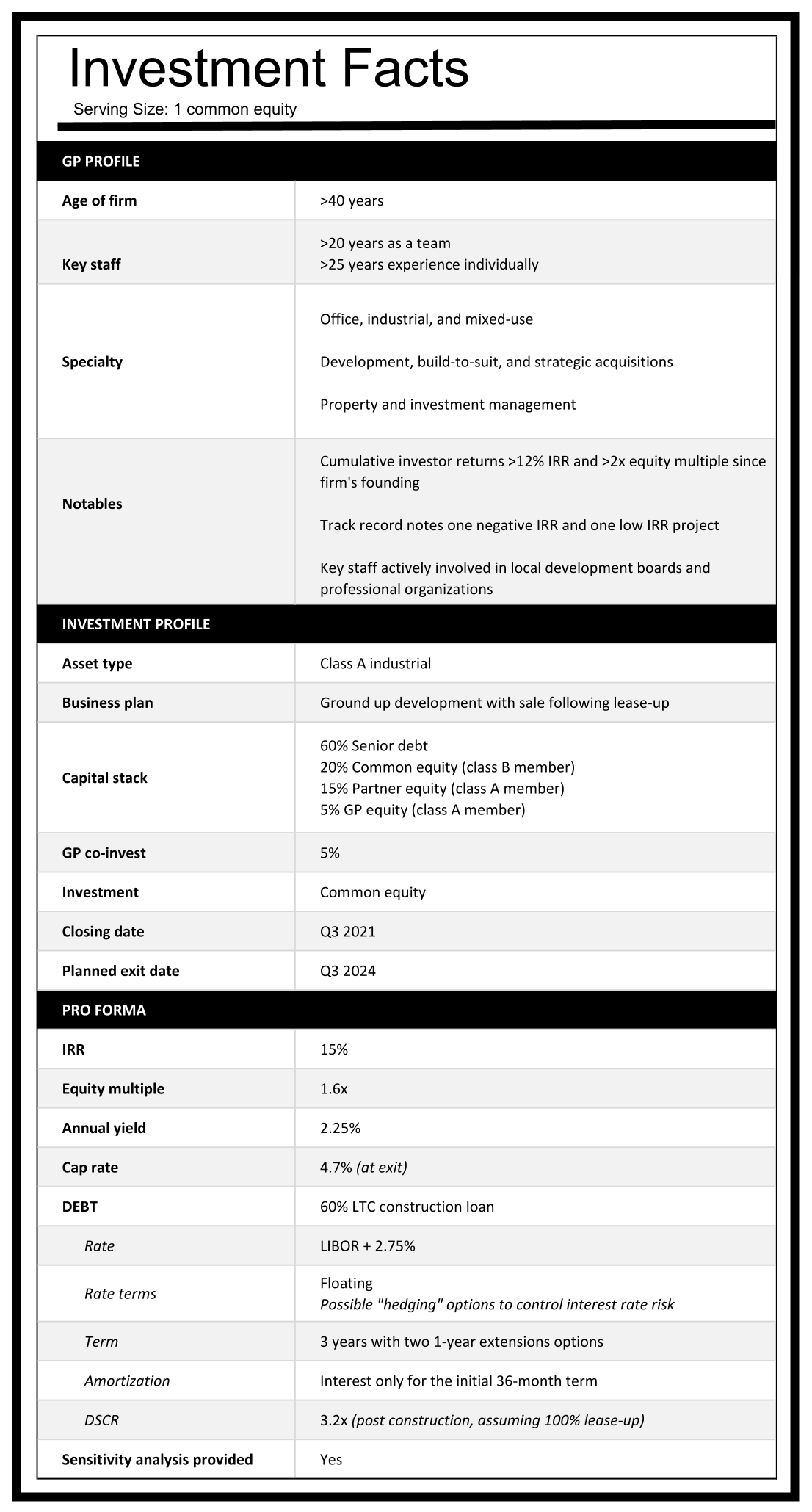
For context, the table below shows the pro forma metrics compared to the 50-year averages for this asset type and sub-market.
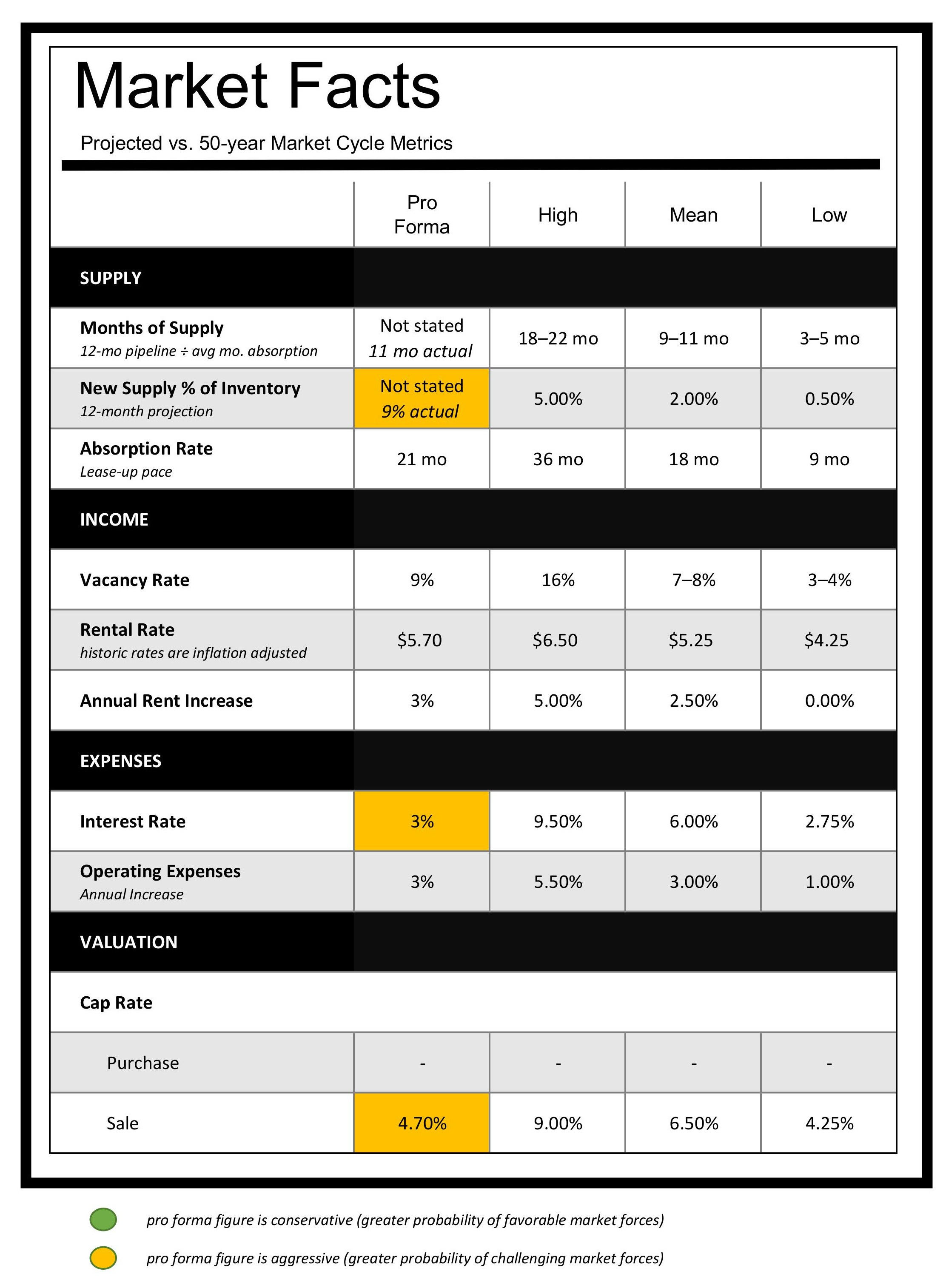
The figures in the two tables illustrate a plan that is mostly aligned with average and relatively conservative underwriting. However, several key metrics assume market forces will hold at favorable extremes - a risky bet, since markets always revert to the mean.
The Reality
The pro forma allows for little deviation on three important points: debt, reserves, and cap rate.
Debt
The short-term nature of the business plan leans on an unsustainable financing structure:
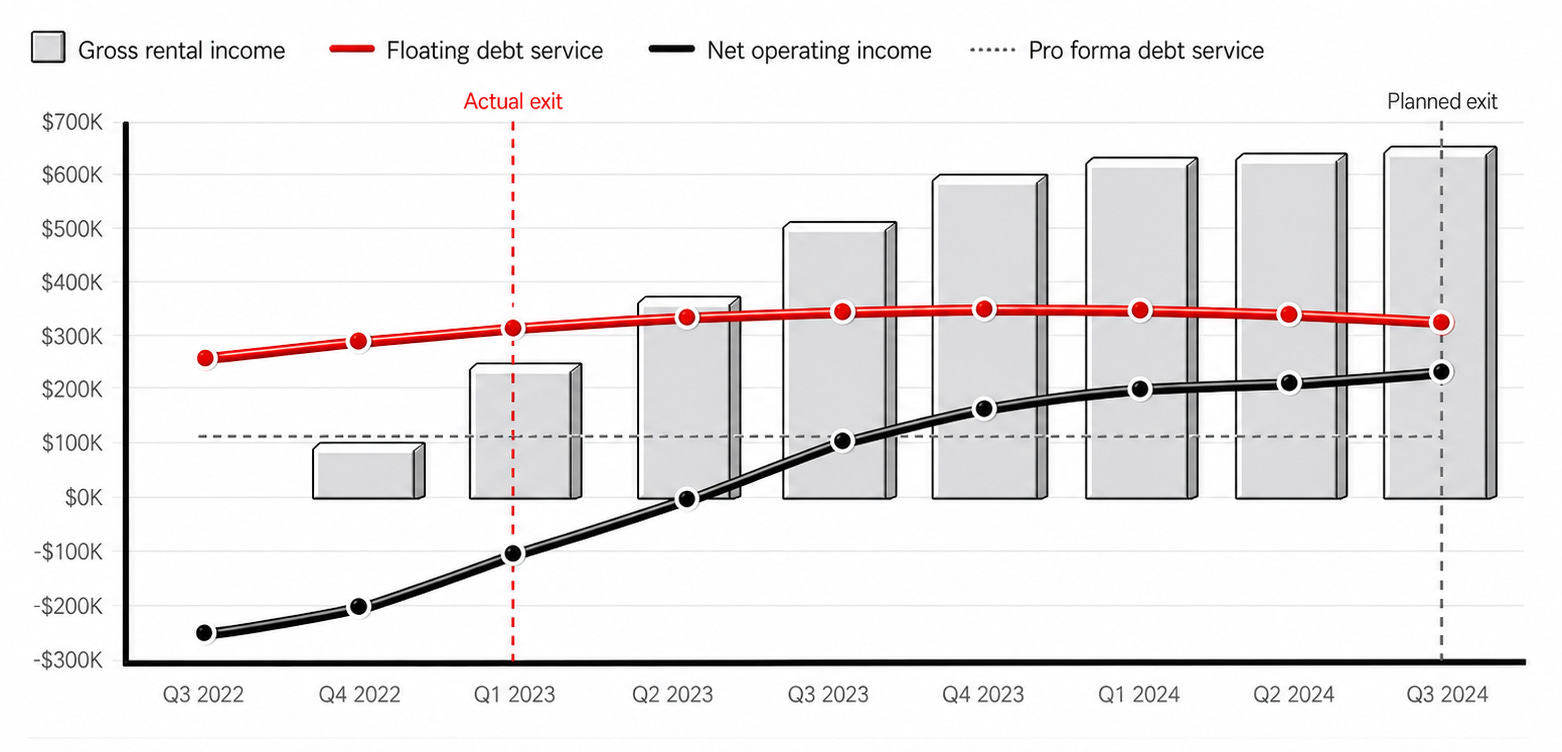
70% of the projected gross rental revenues were dedicated to debt service.
Exposure to rising interest rates from the floating rate debt.
Loan maturity could accommodate limited timeline changes.
Hedging options to control interest rate risk were mentioned but not explained; the actual recognized debt burden was reflective of the floating rate, suggesting hedging was either not implemented or not effective.
Reserves
The budget included 11 months of operating costs post-construction versus the planned five-month lease-up period - a seemingly conservative figure. But, the 11-month reserves were a realistic allowance in light of the delivery pipeline and large amount of new inventory under construction - a situation where supply can outpace demand and result in lower income due to prolonged vacancy, incentives, and lower rental rates.
Although in practice the reserves were not needed for lease-up, debt payments quickly eroded the cash available.
Cap Rate
An exit cap rate of 5.5% was required to break even; the assumed 4.7% exit cap rate left little room for market fluctuation that can erode not only profits but common equity.
Thin margins like this can lead to disaster, but the project remained profitable due to two important factors:
Accelerated Timeline
The team included the GP’s long-time lending, architecture, and construction partners who efficiently executed the capitalization and construction phases:
Closed within 30 days of the planned date.
Construction started on time, and was delivered 30% sooner than planned.
No notable construction issues; safety delays were avoided.
Completed just under budget.
Rent Growth
As construction neared completion and strong market demand indicated a brisk lease-up, the GP began soliciting interest from buyers. After confirming the ability to sell at a strong price, the GP abandoned the original lease-up and sale timeline. The project entered into a sale agreement in at the end of 2022, and was completely divested 18 months ahead of schedule.
The Result
The GP accelerated the exit plan, which boosted investor returns:
Equity Multiple
Pro Forma: 1.6x
Actual: 1.7x
IRR
Pro Forma: 15%
Actual: 30%
Timeline
Pro Forma: 36 months
Actual: 18 months
Notice that the absolute investor return (the equity multiple) is not much higher than forecasted, but due to the project exiting in half of the planned time, the IRR doubled.
But, this speedy exit was a necessity; ballooning debt was threatening to quickly deplete reserves and negative cash flow was imminent. If the GP had proceeded with the initial plan, the outcome could have been very different.
If my work has been worth your time, please subscribe.
How this could have gone differently
The following is a hypothetical simulation based on available market data, the deal’s known parameters, and typical lease-up terms.
Net Operating Income
Income: Demand for Class A industrial in this market remained consistently strong through 2025; low vacancy rates and increased pricing per square foot could have increased rental revenue by 40% from the pro forma projections. Although rental rates doubled over the planned lifetime of the project, lease-ups could have captured only a portion of this value due to limited contractual lease increases.
Expenses: During the planned lease-up period operating expenses rose far beyond the 3% annualized assumption: insurance grew by 20%, and utilities by 10%. Although these costs would have ultimately been borne by the tenants, the inflated operating costs could have accelerated the depletion of reserves during the lease-up period.
More importantly, the dramatic increase in interest rates in 2023 through 2024 could have increased the total debt burden by 2.5x - a substantial hit to positive cash flow. The interest rate reserves would have been quickly exhausted and the project could have been cash flow negative by Q1 2023 - well in advance of being fully leased by Q3 2023. Additional capital of at least 5% pro rata would have been required and possibly diluted common equity investors’ position (depending on how the GP chose to structure this capital infusion).
Net Result: Gross income grew faster than the combined drag of inflated operating costs and debt burden, which could have kept operating revenue positive but not without a bridge of additional capital to prevent default on the senior debt during the lease-up period.
Valuation
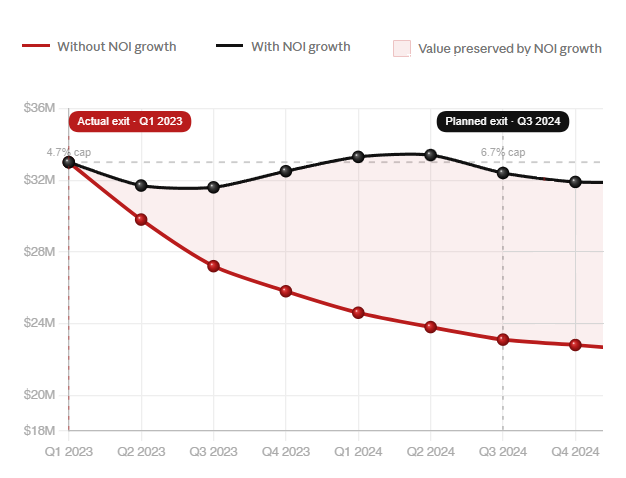
Cap rates moved just as quickly as interest rates. By late 2023, cap rates had expanded to 6% and continued to climb to nearly 7% by the end of 2025. The sale in early 2023 at a 4.7% cap rate was possibly the last of its kind.
The expansion of cap rates can be a death sentence for common equity, but not in this case. The increasing rental income more than compensated for the 30% reduction in underlying valuation resulting from the expanded cap rates.
Exit Metrics
Rapid income growth more than compensated for the substantially larger debt load and expanded cap rate. As simulated, the project could have returned an approximate 8% IRR to investors. Not a bad outcome, but not half of what was originally planned and not reflective of the risk premium for a ground-up deal.
Bottom Line
An experienced GP that delivers reliable results and offers carefully underwritten deals can minimize operational and deal-level risk. However, market risk cannot be controlled; only anticipated.
This deal came at a time of historically low interest and cap rates, and high demand and pricing that had been on a positive 10-year trajectory. The risk of market change was high. Although it is impossible to know how and when a market will shift, the longer the run, the higher the likelihood of change.
The GP clearly knew how to navigate their environment: a strong team delivered ahead of schedule, and close monitoring of the NOI trajectory precipitated an early exit. Based on the strong fundamentals of the GP and the market, a total loss was highly unlikely, but the GP’s pivot guaranteed a win and avoided the looming cash flow crisis and increasing market uncertainty.
However, the entry point of this deal was risky: interest rates were anticipated to rise and the financial structure of the deal made no meaningful accommodation for the near-certain rise in debt costs.
So, was the GP lucky or good?
Perhaps a bit of both, but this deal flew very close to the sun. It’s easy to look at the final result and label the GP as a genius. But if the deal hadn’t gone well, would this same GP be labeled incompetent? Or was this a high-risk deal that delivered returns accordingly?
My Takeaway
I did not see or understand the risks built into this deal when we invested. I got lucky on this one. But many other deals were not so lucky.
In private equity, there is no Morningstar report to help investors assess risk. The metrics were presented in the pitch deck; the risks were evident - but only to those willing and able to see them.
I was not one of those people - until now.