

This is The Debrief - a post-game analysis for LPs. Breaking down the plan, the reality, the result, and key take-aways of real deals to better understand risk and invest accordingly.
To respect the confidentiality of private investment vehicles, all names, locations, and proprietary figures have been anonymized or rounded. Alignment with actual investment metrics is purely coincidental.
The analysis provided is for educational purposes to illustrate market mechanics and risk management.
The Plan
A joint venture between a national financing and regional building expert to deliver a Class A multi-family asset from capitalization through construction, stabilization, and disposition within 36 months.
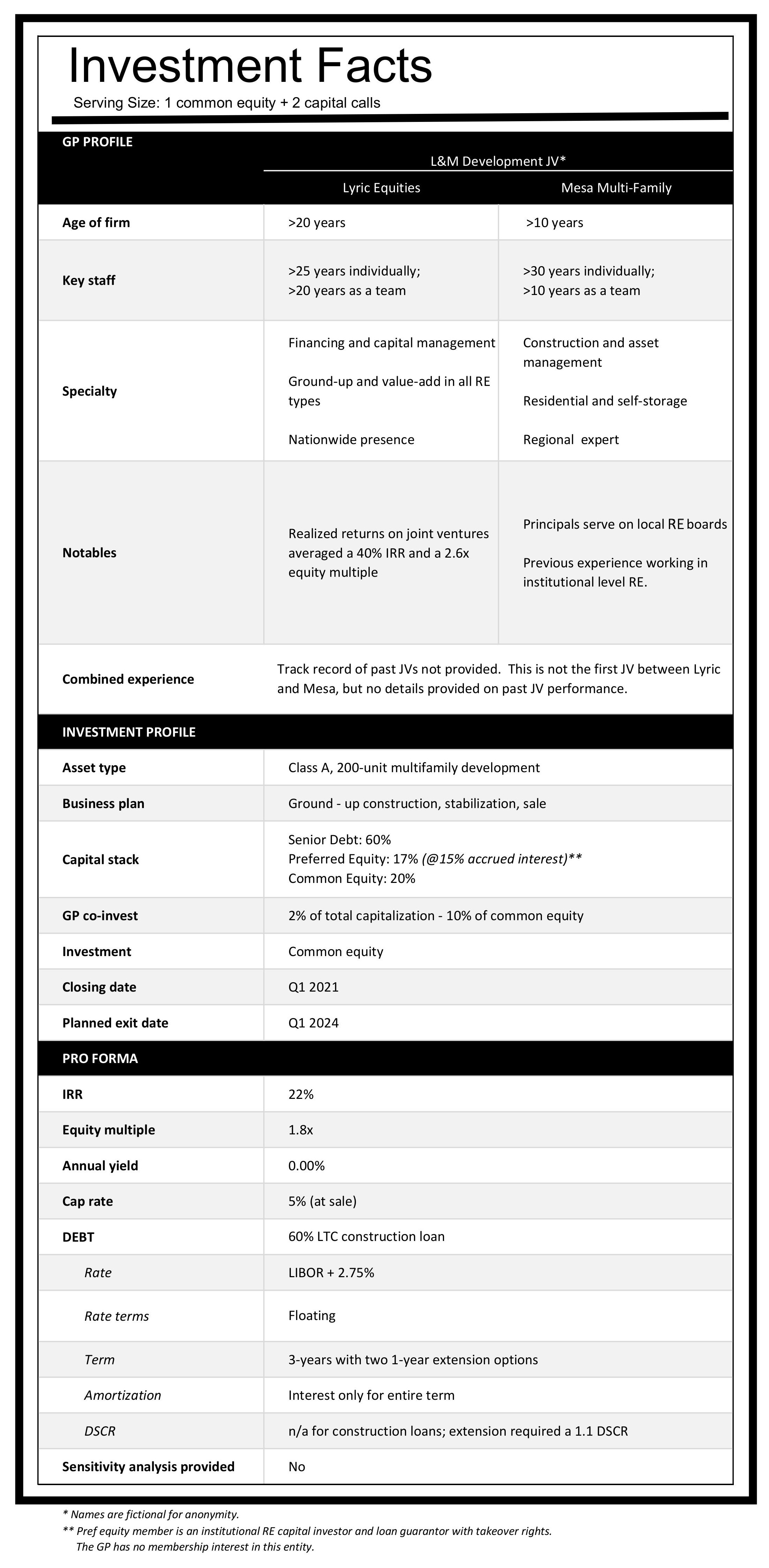
For context, the table below shows the pro forma metrics compared to the 50-year variations for this asset type and sub-market.
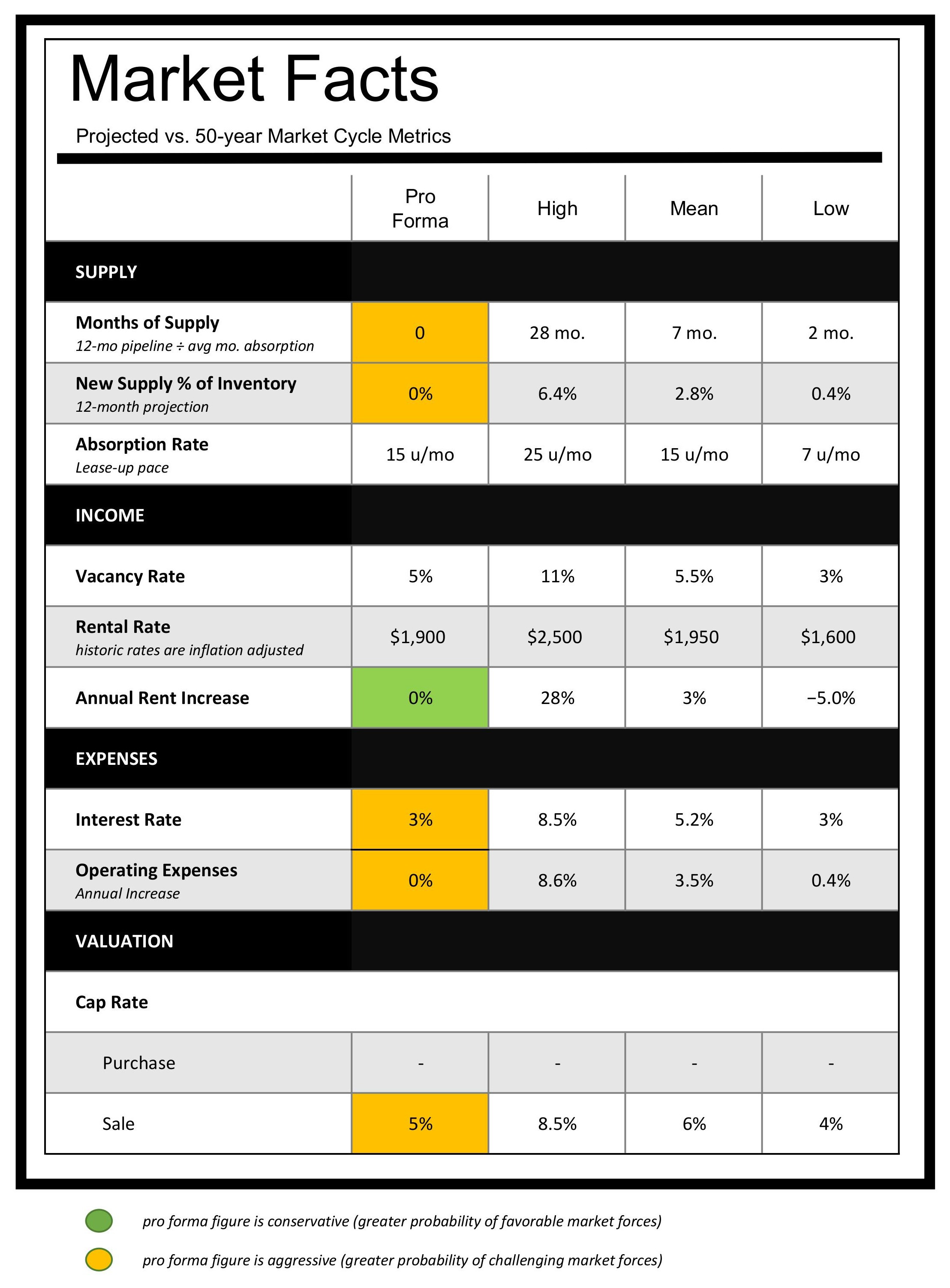
The underwriting for this deal was aggressive on many points. The low interest rate and cap rates were typical for early 2021 when there were no indicators of rising interest rates, and may have been perceived as rational at the time (although a metric at the extreme end of a historic high/low should always be expected to change).
The zero’d supply and new inventory assumptions, while seemingly unrealistic, were based on market data and accurate for the market. A strong demand for rental housing that has no anticipated deliveries is an ideal scenario for a new development - and would be the critical factor that helped offset the exponential debt burden of 2022 and 2023. But rising interest rates were just one of this project’s challenges.
The Reality
The business plan was simple: deliver a large Class A apartment complex to a market with high demand and no supply pipeline. This scenario mitigates the supply/demand risk of new builds and presents a perfect development opportunity, but the project faced a number of challenges during construction that were impossible or difficult to anticipate.
Construction Delays
Permitting. Staff shortages at the City delayed the issuance of the initial construction permit.
Soil Remediation. Soil tests were part of the pre-construction due diligence, but toxic soil was later discovered - a risk that could not have been eliminated.
Supply Chain Disruptions. A nationwide shortage of construction materials emerged in 2021 and severely disrupted the construction timeline in 2022. Although industry reports were warning of delays in 2021, the severity was not apparent until 2022. In response, the GP began stockpiling supplies to mitigate delays.
Inspection Delays. City staffing shortages delayed inspections throughout the construction and delivery period. The timely delivery of permits by municipalities is not reliable due to a number of factors such as budgetary constraints, ebb and flow of demand, and competing priorities. Delays are the norm, not the exception.
Electrification. Due to regional infrastructure issues, the regional power company temporarily diverted supply and connectivity to existing infrastructure, thus delaying the full electrical connection for the project.
Construction was planned to start in Q1 2021 and last 14 to 18 months for delivery in Q3 2022. In reality, full completion was achieved nearly one year behind schedule in Q3 2023. In addition to the construction challenges, the financial environment shifted as well.
Reserves
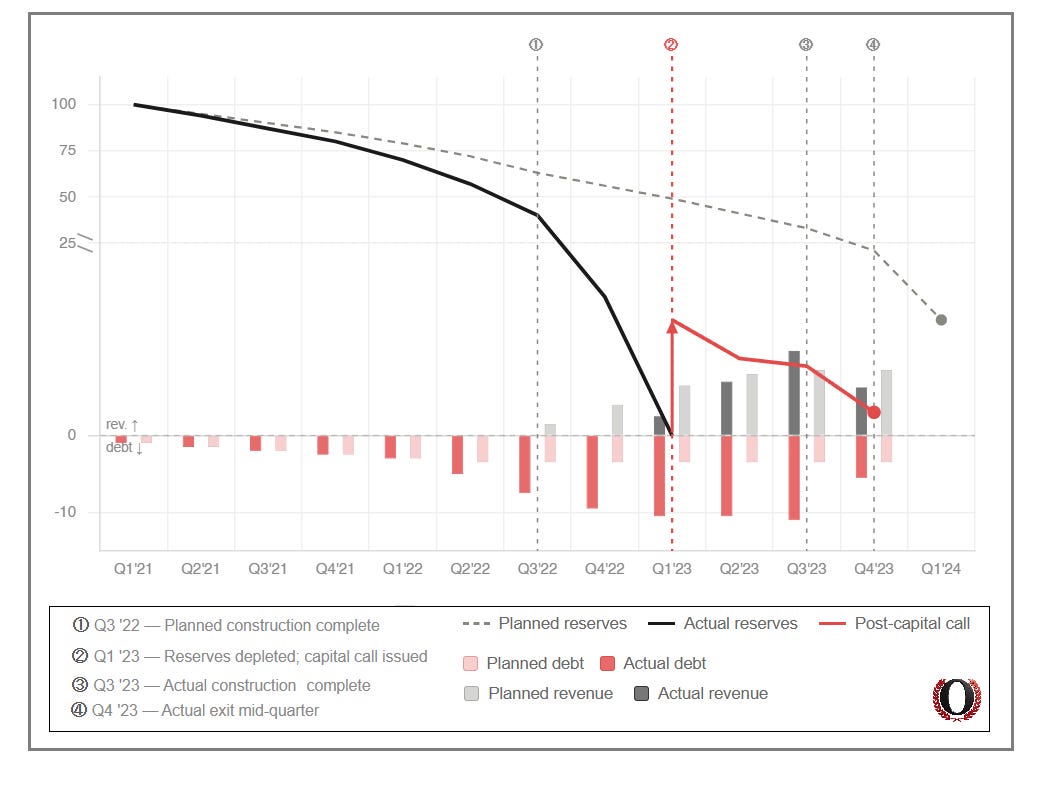
The project’s financial plans were solid. The construction was completed within budget and despite the extended construction timeline, there were adequate reserves to absorb construction delays through Q1 2024 - a total delay of 18 months from plan. But reserves were depleted after 12 months by Q1 2023 - 6 months in advance of construction completion and nearly 12 months before projected depletion. What went wrong?
Interest Rates
At the time of the offering in Q1 2021, there were no signs of inflation and imminent interest rate risk. The pro forma reflected this in assuming a 3% debt burden through the anticipated timeline of the project. Unfortunately, interest rates rose throughout the construction period from Q1 2022 through the exit in Q4 2023. This effectively doubled and then tripled the debt burden of the project, which quickly depleted the reserves.
Lease Up
Market demand greatly outperformed expectations, delivering a 25% rental premium and a lease up pace nearly double over the pro forma rates. This effectively provided 1.25x more gross income in half the time planned.
So, we have a significant construction delay that was offset by an accelerated lease up rate, and ballooning debt expense offset by insatiable market demand. What was the net result?
A capital call.
The Problem
The ups and downs experienced by this deal illuminate the importance of understanding how cash flow over the life of a project translates into investor returns. Or losses.
To recap the series of events from the perspective of the LP in the common equity position:
Q1 2021: Capitalization.
Q1 2022: Project has minor delays from permitting and soil remediation.
Q1 2023: Project is significantly behind schedule due to supply shortages, permitting, and electrification delays. 15% of the units have been pre-leased at a 25% premium. The occupancy permit is anticipated any day, but is not yet received.
- and -LPs receive a capital call for an additional 20% of their original capital investment.
Would you fund the capital call?
Let’s break down the situation to better understand the project’s financial position, why an LP may or may not choose to participate, and how well the GP managed this situation.
If my work has been worth your time, please subscribe.
Evaluating the Capital Call
The project has been greatly delayed and carries a ballooning debt burden. But gross revenue from pre-leasing activity is outpacing expectations. Is there a realistic exit for common equity investors?
The GP’s case for the capital call:
Amount
20% pro rata for LPs and the GP.
Use of Funds
Replenish reserves to cover an additional 8 months of expenses:
Debt burden
Interest on the full senior loan was now 3x pro forma.Operations
6 months of negative NOI projected before rental income provides positive cash flow.Insurance
Delays required prolongation of the construction insurance.
Reasons for Participation
Strong revenue indicators
Pre-leases were 25% higher and application volume 2x greater than expected.Increased valuation
Higher rents translated to a higher sale price; broker opinions were 20% higher than the pro forma sale price. Cap rates were ~3.6%; the projected value reflected a “conservative” 4.4% cap rate.Reliable returns
The higher valuation kept the yield on cost consistent with pro forma investor returns.Dilution risk
Non participating members would have their interest diluted at 1.5:1 and participating members would be permitted to increase their share proportionally.
But we can’t take the GP’s word at face value. Let’s do a few reality checks…
Amount and Use
The capital call documents provided a thorough analysis for LPs to clearly understand the project’s current financial situation, how the additional funds would be used as a bridge to an exit, and why the negative cash flow was a temporary situation. The GP clearly and transparently explained:
How and why the projected budget was short of funds.
What the additional funds would be used for and how the total amount needed was calculated. This included a 1-month buffer.
Viability metrics demonstrated how and when the project would become cash flow positive, and how investors’ capital would be returned.
The following graphic shows how the planned and actual cash flow had run short, and the projected cash flows through exit.
Gross Revenue
Despite the strong pre-leasing activity, could strong gross revenues be anticipated to continue?
Market reports for Q4 2022 and Q1 2023 reported the following for similar projects in the region:
Vacancy: ~6% anticipated to rise due to delivery of new supply.
Rents: +3% YoY increase anticipated to slow from 10% YoY in 2021/22 to 1% in 2023 due to new supply.
Deliveries: 8% of total inventory - a historic wave of inventory anticipated to arrive in 2023 - 2024.
Cap rate: 3.6% and rising due to rising interest rates, although institutional appetite for Class A multi-family was persisting and keeping cap rates relatively low.
2023 was showing the signs of a waning market: although fundamentals were still strong, the double-digit market gains of 2021 and 2022 were coming to an end. Anticipated softening demand due to new deliveries coupled with increasing interest rates foretold a high probability of market gains slowing or possibly reversing.
Notice how the inventory of new deliveries went from zero to 8% in two years. The data is correct but assuming that supply will not arrive to meet demand is incorrect.
Waterfall Returns
Remember that this deal had several hurdles before returning anything to common equity investors: first the senior debt, and second the pref equity. Neither of these parties were asked or obligated to contribute additional capital. Common equity - the LPs - were at the greatest risk and were being asked to risk more capital.
If the project failed to exit in time, a snowballing effect of debt could occur:
Senior debt would continue to burden cash flow, and the lender could potentially require additional capital to fund a rate cap and/or buy down the principal to meet lender LTV and DSCR requirements. However, the projected gross income and valuation easily exceeded the minimum loan performance requirements, so loan default or modification was unlikely if demand did not soften.
Pref equity returns would increase by 5pts - thus more rapidly eroding equity available to LPs. Moreover, the pref equity entity had the right to take control of the asset to protect their interests, which could include forcing a sale. In this worst-case scenario, the interests of LPs would not be considered, and common equity possibly lost. Since the GP presented a viable path to a sale, this scenario was not imminent, but is a real risk to common equity investors.
What would you do? Would you fund the capital call?
The Result
LPs funded 80% of the capital call in the first round in early 2023. A second capital call was made several months later to give LPs the opportunity to fund the 20% shortfall. This was fully funded by LPs, which shifted the position of individual common equity investors but kept the overall capital stack unchanged.
In Q4 2023, the project was sold several months ahead of schedule, at a 4% cap rate, and netted more than 20% profit than anticipated. Approximately 25% of the reserves funded by the capital call were unspent at closing. The capital call successfully provided the bridge to the envisioned exit, which translated into investor returns of:
Equity multiple
Pro forma: 1.7x
Actual: 1.8x
Timeline
Pro forma: 36 months
Actual: 32 months
IRR
Pro forma: 22%
Actual: 32% (fully funded capital call) | 15% (did not fund capital call)
Notice that the 50% greater IRR for fully-funded LPs does not translate into a substantially larger numerical figure (the equity multiple increased by only 5%). The 10% quicker exit and the dilution dynamics of the capital call are the primary drivers of the 50% increase in IRR.
Bottom Line
A capital call does not mean a GP is irresponsible. Evaluating a capital call is just as nuanced as evaluating a new investment.
The GP had a choice when facing the cash flow shortage: make a capital call or find an alternative funding source. The subscription documents permitted the GP to source funds via many options - including a company loan or additional layers of debt. Either of these options could have been logistically easier for the GP, but would have diluted LPs’ common equity interest and probably carried high interest obligations typical of rescue capital, mezzanine debt, or partner loans. As a result, this same exit could have provided LPs with substantially lower returns, and possibly eroded equity to the point of not fully funding the original capital.
By coming to LPs first with a strong case for the capital call, the GP showed fairness and regard for LP interests. By coming to LPs the second time, the GP confirmed their commitment to investor interests. LPs were asked to take on additional risk, but the GP had the integrity to be transparent, honest, and not dilute LPs without their consent.
So, when a GP touts “never issued a capital call” is that really something to brag about?
Thank you to my subscribers!
This post exists because a reader trusted me with their experience. Thank you.
If you value The Debrief, please consider sharing a deal for review.